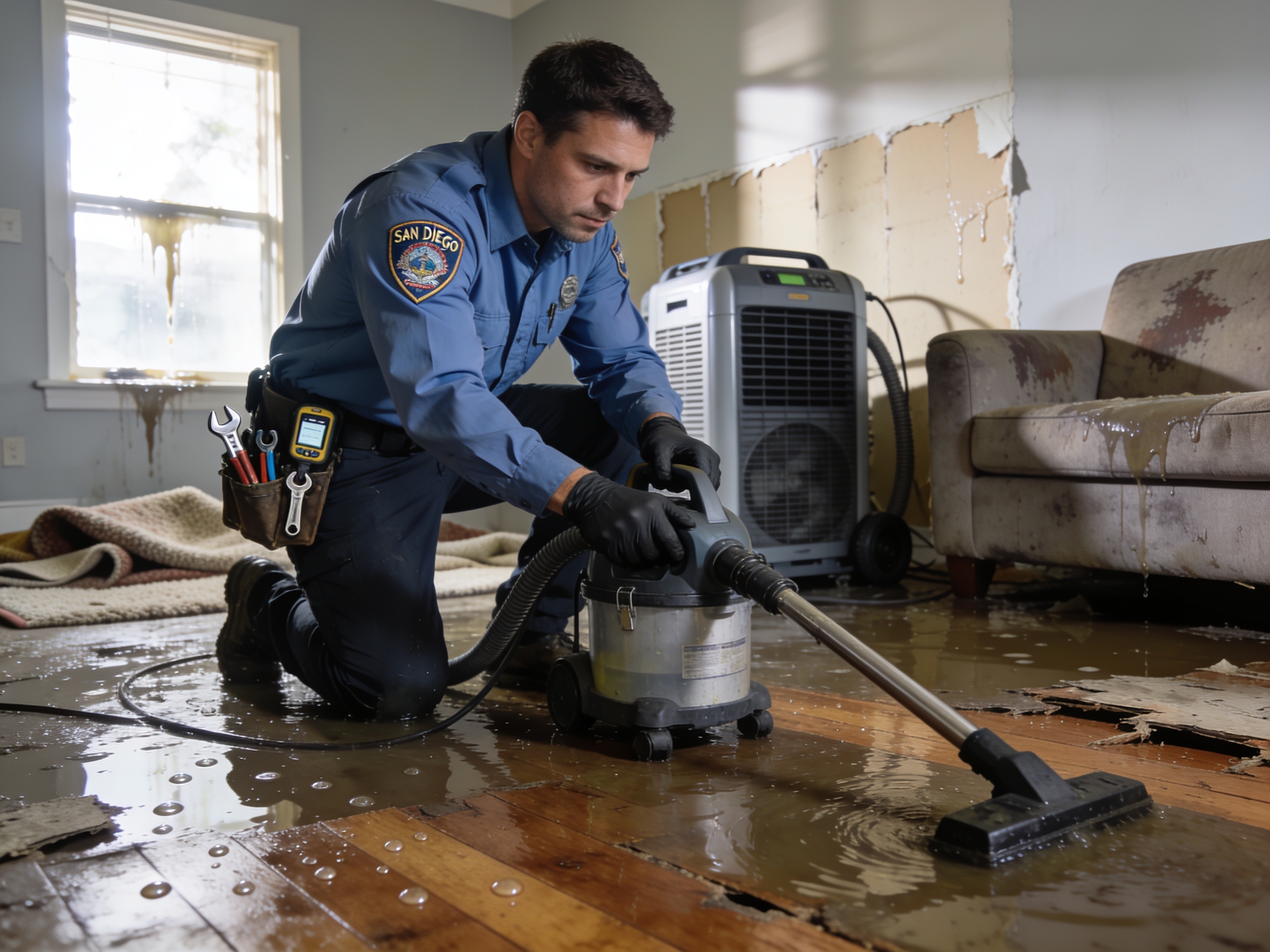
San Diego homes built before 1970 in North Park and Mission Valley often contain plaster walls and slab-on-grade foundations that trap moisture after leaks from galvanized supply lines. When a pipe bursts, water migrates under tile or hardwood faster than in newer builds, requiring moisture meters to map hidden saturation before mold sets in during the mild but humid coastal nights. Technicians at 10801 Vista Sorrento Pkwy respond within hours to prevent secondary damage that can affect neighboring units in multi-family buildings common downtown.
The county’s Mediterranean climate delivers most rainfall between November and March, yet sudden appliance failures or roof leaks around La Jolla Cove and Pacific Beach create year-round emergencies. Salt-laden air accelerates corrosion on metal HVAC components and electrical boxes once water reaches them, so restoration crews isolate circuits early and use low-grain dehumidifiers calibrated for 65–75 percent relative humidity typical along the coast. Work in Coronado and Chula Vista follows the same sequence but accounts for higher water tables near the bay that slow natural evaporation.
After extraction, crews place air movers in a directed pattern that follows the home’s actual airflow paths rather than a standard grid, because many La Jolla and downtown properties have limited crawl space access. This prevents trapped moisture from migrating into adjacent drywall or insulation, which would otherwise require larger demolition later. Final verification uses both pin and pinless meters plus thermal imaging to confirm readings below 12 percent moisture content before any reconstruction begins.
Technician insight
In San Diego the thing that catches most people out with 24/7 water damage restoration is how quickly moisture travels under tile on slab foundations in North Park and Mission Valley homes; the mild climate keeps the slab warm enough that water doesn’t pool visibly yet still saturates subfloor adhesive, so you have to pull baseboards and check with meters within the first few hours or the job doubles in size.
Slab Leak In North Park Bungalow
A homeowner noticed damp carpet near the kitchen after a supply line failed. We found water had wicked 18 inches under the slab edge and into two adjacent plaster walls. Extraction and targeted drying of the slab perimeter plus selective drywall removal kept the original hardwood intact; the home was dry and ready for flooring reinstall within five days.
24/7 Water Damage Restoration Services We Offer
✓Emergency Water Extraction
Rapid removal of standing water from living spaces and subfloors in single-family homes and condos throughout San Diego County to limit migration into adjacent units.
✓Structural Drying and Dehumidification
Placement of commercial air movers and low-grain dehumidifiers sized for coastal humidity levels to dry wall cavities and slab edges in North Park and Mission Valley properties.
✓Mold Prevention After Water Intrusion
Application of EPA-registered antimicrobials and HEPA air scrubbing on affected materials before hidden growth develops during San Diego’s mild overnight temperatures.
✓Hardwood and Tile Floor Restoration
Controlled drying and refinishing of wood floors plus removal and reinstallation of tile over slab foundations common in La Jolla and Pacific Beach homes.
✓Drywall and Insulation Replacement
Selective demolition and replacement of saturated drywall and insulation in older North Park and downtown buildings while preserving original plaster where possible.
24/7 Water Damage Restoration Cost in San Diego, CA
| Service | Typical Range | What Affects It |
|---|---|---|
| Initial Assessment And Moisture Mapping | $150–$350 | Varies with number of rooms and access to crawl spaces or attics. |
| Water Extraction Per 1,000 Sq Ft | $400–$900 | Higher when slab edges or finished basements are involved. |
| Equipment Drying Package (3–5 Days) | $800–$2,200 | Based on dehumidifier count needed for coastal humidity. |
| Drywall Removal And Disposal | $2–$4 per sq ft | Includes containment and haul-away in older North Park homes. |
Ranges are typical for San Diego, CA and confirmed with an exact written quote before any work starts.
How it works
- 1
On-Site Assessment
Technicians arrive 24/7, document moisture levels with meters and thermal imaging, and map affected areas in homes from La Jolla to Chula Vista.
- 2
Water Extraction
Standing water is removed using truck-mounted and portable pumps, followed by immediate containment to protect unaffected rooms.
- 3
Drying And Monitoring
Equipment is staged and checked daily until moisture readings stabilize, with adjustments made for San Diego’s typical coastal humidity.
- 4
Final Verification And Handover
Post-drying inspection confirms safe moisture levels before any reconstruction or contents return.
Pricing
Costs depend on square footage affected, depth of saturation, and whether slab or multi-story drying is required.